(Actually we need 14 coz other people take their time! )
On the first day of homeschool my neighbor said to me, "Can you homeschool legally?"
On the second day of homeschool my neighbor said to me, "Are they socialized, can you homeschool legally?"
On the third day of homeschool my neighbor said to me, "Do you give them tests, are they socialized, can you homeschool legally?"
On the fourth day of homeschool my neighbor said to me, "What about P.E., do you give them tests, are they socialized, can you homeschool legally?"
On the fifth day of homeschool my neighbor said to me, "YOU ARE SO STRANGE, What about P.E., do you give them tests, are they socialized, can you homeschool legally?"
On the sixth day of homeschool my neighbor said to me, "How long will you homeschool, YOU ARE SO STRANGE, What about P.E., do you give them tests, are they socialized, can you homeschool legally?"
On the seventh day of homeschool my neighbor said to me, "Look at what they're missing, how long will you homeschool, YOU ARE SO STRANGE, What about P.E., do you give them tests, are they socialized, can you homeschool legally?"
On the eighth day of homeschool my neighbor said to me, "Why do you do this, look at what they're missing, how long will you homeschool, YOU ARE SO STRANGE, What about P.E., do you give them tests, are they socialized, can you homeschool legally?"
On the ninth day of homeschool my neighbor said to me, "They'll miss the prom, why do you do this, look at what they're missing, how long will you homeschool, YOU ARE SO STRANGE, What about P.E., do you give them tests, are they socialized, can you homeschool legally?"
On the tenth day of homeschool my neighbor said to me, "What about graduation, they'll miss the prom, why do you do this, look at what they're missing, how long will you homeschool, YOU ARE SO STRANGE, What about P.E., do you give them tests, are they socialized, can you
homeschool legally?"
On the eleventh day of homeschool my neighbor said to me, "I could never do that, what about graduation, they'll miss the prom, why do you do this, look at what they're missing, how long will you homeschool, YOU ARE SO STRANGE, What about P.E., do you give them tests, are they socialized, can you homeschool legally?"
On the twelfth day of homeschool my neighbor said to me, "Can they go to college, I could never do that, what about graduation, they'll miss the prom, why do you do this, look at what they're missing, how long will you homeschool, YOU ARE SO STRANGE, What about P.E., do you
give them tests, are they socialized, can you homeschool legally?"
On the thirteenth day of homeschool I thoughtfully replied, "They can go to college, yes you can do this, they can have graduation, we can do a prom, we do it cuz we like it, they are missing nothing, we'll homeschool forever, WE ARE NOT STRANGE. We give them P.E., and can take test if they want to, they are socialized, AND WE HOMESCHOOL LEGALLY!"
On the fourteenth day of homeschool my neighbor said to me, "How can I get started, why didn't you tell me, where do I buy cirriculum, when is the next conference, WILL PEOPLE THINK WE'RE STRANGE?, I think we can do this, if you will help us, we'll join a sports team,
and we'll homeschool legally.
Thanks: DL, but please don't go to Boston!
Wednesday, January 17, 2007


Sunday, January 14, 2007
On Why the State Shouldn't DARE to Prescribe the Content of Education
...quite simply, because a one-size will not fit all children.
From Ann's Blog:
"Anyway on arriving home, Lucy went straight to her laptop and signed into MSN to chat to her friends all over the country - again something I doubted at times that she would ever manage without me! She caught up with another home ed friend ‘Melissa’ last week who she hasn’t been in contact with since Peak camp ‘05, just before this particular friends family moved abroad. Melissa was flabbergasted that this was actually Lucy typing on MSN. Her comment was “Your writing and spelling are so much better - you couldn’t have done this when I saw you last - I wouldn’t have been able to understand you!” but of course, like most 14 year olds Lucy wants to be able to converse with her friends and this has been a huge motivation for her - and a jolly fun way of practising too! "
The tools to get on MSN, someone there just to shout out spellings when needed but not to get in the way otherwise, will the state prescribe this in their curriculums? Not likely, I would say, yet this is the way that Lucy, and hundreds of other HE children who have been failed by the state system, have learnt how to express their thoughts clearly in writing.
From Ann's Blog:
"Anyway on arriving home, Lucy went straight to her laptop and signed into MSN to chat to her friends all over the country - again something I doubted at times that she would ever manage without me! She caught up with another home ed friend ‘Melissa’ last week who she hasn’t been in contact with since Peak camp ‘05, just before this particular friends family moved abroad. Melissa was flabbergasted that this was actually Lucy typing on MSN. Her comment was “Your writing and spelling are so much better - you couldn’t have done this when I saw you last - I wouldn’t have been able to understand you!” but of course, like most 14 year olds Lucy wants to be able to converse with her friends and this has been a huge motivation for her - and a jolly fun way of practising too! "
The tools to get on MSN, someone there just to shout out spellings when needed but not to get in the way otherwise, will the state prescribe this in their curriculums? Not likely, I would say, yet this is the way that Lucy, and hundreds of other HE children who have been failed by the state system, have learnt how to express their thoughts clearly in writing.
Saturday, January 13, 2007
Charles Moore on Ruth Kelly
Charles Moore in the Spectator this week:
"Obviously Ruth Kelly is a 'hypocrite', but the hypocrites in her party are more admirable than the consistent ones. At least the former show some human feeling. There must be Labour ministers who know that their children would be better off in a private school, can afford to send them there, and still don't, because of their careers and their opinions. That really is disgusting. it will be interesting to see whether young Leo Blair finds his way into a private school once his father leaves office.
"Miss Kelly pleads her son's special needs. In this area, Labour is truly hoist with its own petard. It has been the slave to a doctrine - the classrom equivalent of 'care in the community' for the mentally ill - which says that all children benefit from being among normal children, and so it has closed special needs schools. The truth is that some children with special needs - most notably those with autism - are positively damaged by going to ordinary schools. And in all schools it is hard to find time, energy and teachers to deal with special and normal needs at once. Miss Kelly seems to have found this out the hard way, and acted against her government's policy and in fovour of her son.
This process ought to give Labour politicians pause. What Ruth Kelly is doing is what every parent would hope to be able to do - thinking about her child's special needs (and there is a sense in which every child's needs are special) and choosing what is best for him.
How many more generations have to be wasted before it is accepted by all parties that this choice should be a source of pride, not shame?
Good one Charles! As you rightly observe, the right and duty of the parent/guardian to provide an education suitable to the age, ability and aptitude of the child is something for which we should fight. We therefore expect the Spectator to be behind the Home Educating community who do take the individual educational needs of their children seriously, since the right to home educate their children as parents see fit, enshrines the notion of parental responsibility and tailored education.
"Obviously Ruth Kelly is a 'hypocrite', but the hypocrites in her party are more admirable than the consistent ones. At least the former show some human feeling. There must be Labour ministers who know that their children would be better off in a private school, can afford to send them there, and still don't, because of their careers and their opinions. That really is disgusting. it will be interesting to see whether young Leo Blair finds his way into a private school once his father leaves office.
"Miss Kelly pleads her son's special needs. In this area, Labour is truly hoist with its own petard. It has been the slave to a doctrine - the classrom equivalent of 'care in the community' for the mentally ill - which says that all children benefit from being among normal children, and so it has closed special needs schools. The truth is that some children with special needs - most notably those with autism - are positively damaged by going to ordinary schools. And in all schools it is hard to find time, energy and teachers to deal with special and normal needs at once. Miss Kelly seems to have found this out the hard way, and acted against her government's policy and in fovour of her son.
This process ought to give Labour politicians pause. What Ruth Kelly is doing is what every parent would hope to be able to do - thinking about her child's special needs (and there is a sense in which every child's needs are special) and choosing what is best for him.
How many more generations have to be wasted before it is accepted by all parties that this choice should be a source of pride, not shame?
Good one Charles! As you rightly observe, the right and duty of the parent/guardian to provide an education suitable to the age, ability and aptitude of the child is something for which we should fight. We therefore expect the Spectator to be behind the Home Educating community who do take the individual educational needs of their children seriously, since the right to home educate their children as parents see fit, enshrines the notion of parental responsibility and tailored education.
Rugby - The Home Ed Way
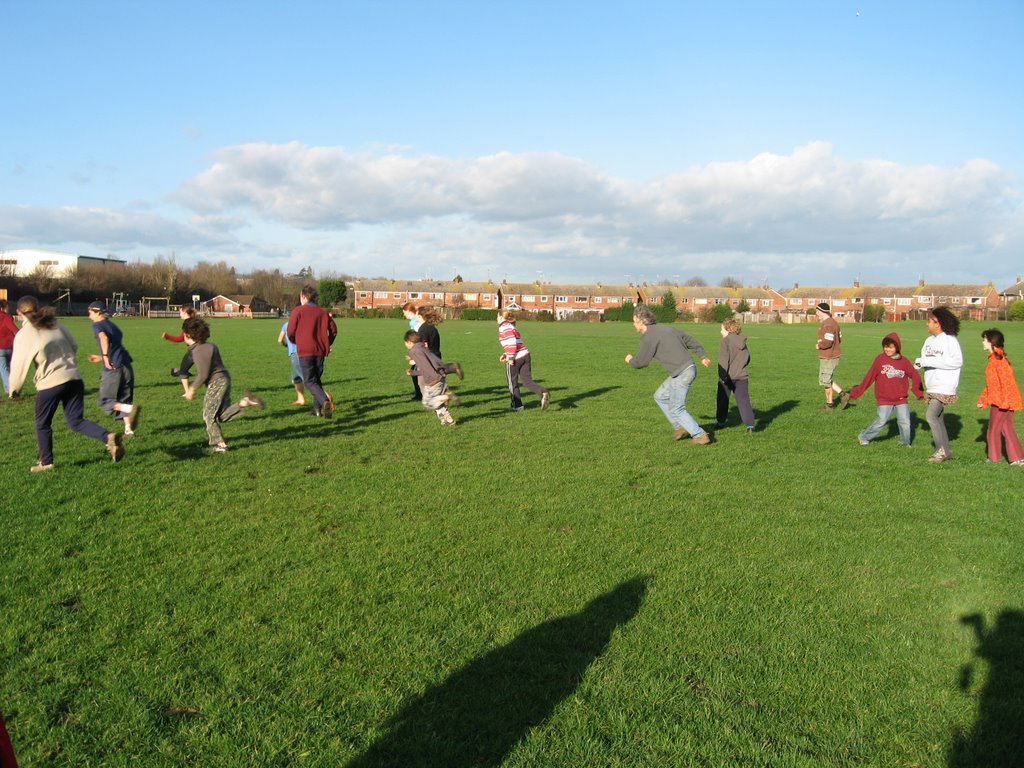
They played this time for about 90 mins without stopping, except for quick discussions: all ages, both sexes, with the players who know what they are doing gradually refining the game, so that we have proper line-outs, off-side rules, knock-on rules and no handling in the ruck, etc.
Despite the age gaps and range of skill, no-one is hurt over and beyond a few bruises, and all of them LOVE it. No-one has to play if they don't want to, and actually quite a lot of them are frighteningly good.

Friday, January 12, 2007
David Willetts on The Children's Database
Here's the Tory Shadow Education Secretary and MP for Havant making sense on the matter of the Information Sharing Index:
"That's why the first thing we've got to do is to support parents. It's very tough being a parent in Britain today. The last thing they need is an endless flow of new laws and new regulations telling them how they should raise their own children. Why on earth is the Government introducing a national computer register for every child in the country? We're going to have barcoded babies. We don't need it. That money should be better spent targeted on the families that really need the help. "
And for another reason why the Government should really think through the matter of the ISI, go to ARCH Blog's post How Libellous is Your Database?
"That's why the first thing we've got to do is to support parents. It's very tough being a parent in Britain today. The last thing they need is an endless flow of new laws and new regulations telling them how they should raise their own children. Why on earth is the Government introducing a national computer register for every child in the country? We're going to have barcoded babies. We don't need it. That money should be better spent targeted on the families that really need the help. "
And for another reason why the Government should really think through the matter of the ISI, go to ARCH Blog's post How Libellous is Your Database?
Who is Responsible for Determining the Nature of a Suitable Education? The Argument in 2007.
From Lord Adonis, (the Schools Minister), we hear that:
"The state does not currently prescribe what form of education parents should provide, whilst all maintained and independent school provision is prescribed in legislation and subject to inspection. This anomaly is at odds with Every Child Matters reforms, supported by the Children Act 2004, which set out the Government's aim to improve educational outcomes for all children, regardless of where they are educated, and to narrow the gap between those who are doing well and those who are not."
Ok, so here goes! Let us go down that potentially rocky road which deals with the issue of who is responsible for what, shall we, Lord Adonis?
I would argue that in the act of determining what kind of education can take place, and in the act of delegating the responsibility to provide such an education to our children, the state would ultimately be entirely responsible for the education of our children. How could it be otherwise? If something goes horribly wrong with the education of a child when they are being educated as the state prescribes and delegates, then who is ultimately responsible for this failure?
The answer seems clear. It is the state who must answer the case.
So Lord Adonis, if you make us, we will do exactly what you say. We will make our children follow your educational prescriptions, but it will fail a significant proportion of them (just as it does in schools). Indeed, I can very confidently predict that it will fail at least one of my children SO badly that I will come after you to prove that it is your responsibility that his education has not worked for him. You may try to screw us on the basis of provision, but when we are forced to do your bidding, it seems almost impossible to see how you won't escape culpability when we screw you for responsibility for an unsuitable form and content of education.
That is not an empty threat. We will do it if we have to.
"The state does not currently prescribe what form of education parents should provide, whilst all maintained and independent school provision is prescribed in legislation and subject to inspection. This anomaly is at odds with Every Child Matters reforms, supported by the Children Act 2004, which set out the Government's aim to improve educational outcomes for all children, regardless of where they are educated, and to narrow the gap between those who are doing well and those who are not."
Ok, so here goes! Let us go down that potentially rocky road which deals with the issue of who is responsible for what, shall we, Lord Adonis?
I would argue that in the act of determining what kind of education can take place, and in the act of delegating the responsibility to provide such an education to our children, the state would ultimately be entirely responsible for the education of our children. How could it be otherwise? If something goes horribly wrong with the education of a child when they are being educated as the state prescribes and delegates, then who is ultimately responsible for this failure?
The answer seems clear. It is the state who must answer the case.
So Lord Adonis, if you make us, we will do exactly what you say. We will make our children follow your educational prescriptions, but it will fail a significant proportion of them (just as it does in schools). Indeed, I can very confidently predict that it will fail at least one of my children SO badly that I will come after you to prove that it is your responsibility that his education has not worked for him. You may try to screw us on the basis of provision, but when we are forced to do your bidding, it seems almost impossible to see how you won't escape culpability when we screw you for responsibility for an unsuitable form and content of education.
That is not an empty threat. We will do it if we have to.
Youth on Youth Crime.
Wonder where all this mugging is taking place? I even question one in five bit and suspect that the figure of unreported pinching of property is far higher.
Thursday, January 11, 2007
Tidy Those Shelves

By way of marking the fact that I think we are busted, (the LA know about us), this is me!
Contacting Traveller Education Support Services
Thanks to Tech's prompting, I have found this Directory of Traveller Education Services and am about to rattle off a few mails to those around my area to see whether I can get some more feedback on the Ivatts Report.
The sort of letter I will be sending:
Dear ........
I wonder if you can help me.
I am a home educating parent working with a home education charity which has been set up to look at government initiatives, work practices and legislation as it relates to home education.
You are probably well aware of the recent Ivatts report about Elective Home Education, particularly as it relates to Traveller and Gypsy/Roma families.
>http://www.dfes.gov.uk/research/data/uploadfiles/RW77.pdf
I would be interested to hear your feelings on any number of the issues described within this report, but particularly:
Is it the case that many Traveller/Gypsy/Roma families are indeed claiming to Home Educate when they are not in fact doing so?
Is it the case that a policy of including many Traveller families in the school system has been a success? How are Traveller children doing in schools?
What happens to children who have been excluded for school or have SENs?
What do travellers think would be the most useful strategy for them in terms of improving the education of their children?
Is it the case that Traveller Support Workers or other such support services have been prevented from working with school age children, perhaps on the basis that they may seduce children away from school or for some other reason?
Would the recommendations in the Ivatts Report, ie that:
"a) a standardised national system of registration be implemented by each local education authority in terms of assessment criteria; monitoring/inspection visits; and the time sequence related to these events,
b) the wishes of children are established and taken into account in the assessment process
d) (sic) a clear curriculum entitlement is defined which is broad and balanced.
e) all children be registered (irrespective of whether they have ever been registered with a school), and that all children registered under EHE are seen initally and in the teaching and learning situation on a regular basis defined in law and a standard format for post visit reports and their distribution
f) all children registered under EHE are assessed on a regular basis in relation to expectations of educational progress.
g)that a timetable be established and defined in relation to the procedures incumbent on local authorities pursuant to assessment judgements of the provision being unsuitable.
h) parents and secondary aged children have the right of appeal at any decision by the appropriate authorities in regard to an application and continuance of elected home education."
be well received by the travelling community?
Thank you in advance for any help you can give me with answers to these questions.
= = = = = = = =
If anyone else has a mo, it would be great if you could ask the TES in your area for their feedback on the Ivatts Report. Do use/adapt letter above though telephone often seems to work better.
The sort of letter I will be sending:
Dear ........
I wonder if you can help me.
I am a home educating parent working with a home education charity which has been set up to look at government initiatives, work practices and legislation as it relates to home education.
You are probably well aware of the recent Ivatts report about Elective Home Education, particularly as it relates to Traveller and Gypsy/Roma families.
>http://www.dfes.gov.uk/research/data/uploadfiles/RW77.pdf
I would be interested to hear your feelings on any number of the issues described within this report, but particularly:
Is it the case that many Traveller/Gypsy/Roma families are indeed claiming to Home Educate when they are not in fact doing so?
Is it the case that a policy of including many Traveller families in the school system has been a success? How are Traveller children doing in schools?
What happens to children who have been excluded for school or have SENs?
What do travellers think would be the most useful strategy for them in terms of improving the education of their children?
Is it the case that Traveller Support Workers or other such support services have been prevented from working with school age children, perhaps on the basis that they may seduce children away from school or for some other reason?
Would the recommendations in the Ivatts Report, ie that:
"a) a standardised national system of registration be implemented by each local education authority in terms of assessment criteria; monitoring/inspection visits; and the time sequence related to these events,
b) the wishes of children are established and taken into account in the assessment process
d) (sic) a clear curriculum entitlement is defined which is broad and balanced.
e) all children be registered (irrespective of whether they have ever been registered with a school), and that all children registered under EHE are seen initally and in the teaching and learning situation on a regular basis defined in law and a standard format for post visit reports and their distribution
f) all children registered under EHE are assessed on a regular basis in relation to expectations of educational progress.
g)that a timetable be established and defined in relation to the procedures incumbent on local authorities pursuant to assessment judgements of the provision being unsuitable.
h) parents and secondary aged children have the right of appeal at any decision by the appropriate authorities in regard to an application and continuance of elected home education."
be well received by the travelling community?
Thank you in advance for any help you can give me with answers to these questions.
= = = = = = = =
If anyone else has a mo, it would be great if you could ask the TES in your area for their feedback on the Ivatts Report. Do use/adapt letter above though telephone often seems to work better.
Wednesday, January 10, 2007
In Answer to Ivatts
Comments upon "Research and Advice Commissioned by the DfES on the situation regarding the current policy provision and practice in EHE for Gypsy, Roma and Traveller Children, by Arthur Ivatts."
Before we go any further, I must admit my knowledge base is extremely limited. More research on this needs to be done, but I would say that it certainly needs to be done before any consultation on Home Education is undertaken. I say this because the conversations I have had with Travellers and with a Traveller Support Worker (TSW) have led me to believe that the Ivatts report is misleading in a number of very significant ways on the matter of the current situation with regard to the education of Gyspy/Roma and Traveller (GRT) children. The report does not match GRTs' perceptions of the situation and far from solving a problem of educational neglect in the UK, (other than by forcing more Travellers to emigrate), will exacerbate the difficulties of educating (GRT) children according to their age, ability and aptitude.
Highlighted below are some of the significant areas of contention which appear to warrant further research, coupled with some suggestions as to how better to solve the problem of educational neglect.
From the Executive Summary of the Ivatts Report.
Page 3.
"1.1. The Traveller Education Services (TESs) have reported on the seemingly marked increase year-on-year of the number of Gypsy/Roma and Traveller families opting for EHE. This has been expressed as a development causing concern given that it is suggested that EHE is being used merely as a device to avoid school attendance without legal penalty. This concern has also been related to the fact that a minority of the parents are judged to be ill-equipped to organize or deliver an education suited to their children's ages, aptitudes and abilities and any special needs they may have. "
The Traveller Support Worker (TSW) to whom I spoke explained that the main contentions above were not a good representation of the situation in her area.
The demographics in her area and in others she knows well are very different from the one drawn by Ivatts in this first paragraph. For example, she only knows of one family who expressly home educate in her area and far from failing their children, they are doing very well. Other Traveller families whose children are not in school are those whose children have been excluded from it. They were not using Home Education as an excuse to avoid school, but rather had been compelled to leave school. These children, who were not classed as being home educated, were often attending Special Pick-Up units, usually on a once-a-week basis. She reports that these units were well-received, though short-funded. So instead of this huge growth in the number of travellers claiming to home educated, what we are actually seeing is a growth in the number of children who have been excluded from and failed by the school system.
The other big and significant demographic trend in traveling communities, which Ivatts fails to mention, is that large numbers of Travellers with children have actually left the country in recent years. This has happened for at least four distinct reasons:
1. That planning permission has become ever increasingly difficult to achieve for Travellers.
2. That people from the Eastern Bloc who have come over here have taken the jobs that Travellers would traditionally have done.
3.That jobs and places to stay are easier to find in, for example, Eastern Bloc countries, so many travellers have actually emigrated there.
4. Most pertinently for our argument, that TESWs have been discouraged from working with children of school age because these services were accused of seducing children away from school. In the area of my informant, this has not resulted in any families claiming to HE when they are not in fact doing so. What it has resulted in is more emigration of Traveller families, since schools, (despite the promises of Ivatts and various other educationalists to improve the school environment) remain far from suitable places for managing an education of traveller children for a number of different reasons.
All these reasons have resulted in travellers leaving the UK. A policy to police home educators even further will doubtless only increase the pressure upon such families to emigrate. Whilst the government may feel that this effectively solves a problem, we cannot help but think that if this is a deliberate policy, it is one that should be made explicitly so, for far from being a policy of inclusion, the government is effecting a policy of excluding some it's citizens.
To summarise here, the TSW I spoke to said that there was no marked increase in the number of people claiming (falsely or otherwise) to home educate, but that the reverse was true: that of the increasingly small number of GRT children who remain in this country, more than ever before had been forced back into the schooling system under threat of fines, and because the Traveller Educational Support Services had been severely curtailed. (See following paragraph); that the children who remain outside the school system are those who have been excluded from it and that this happens because the schools, despite the promises of Ivatts and other educationalists, are not good environments for Traveller children, for a number of reasons, including the high prevalence of bullying and the fear of cultural erosion.
1.9 (page 4)
"Twenty five (25%) of responding LAs do not have a written policy on EHE. While most LAs provide families with initial and post registration advice, only 2 gave practical help in the form of educational materials."
Whilst Home Educators everywhere have never expected any help from LAs, the implication in the above paragraph seems to be that there is some significant barrier to these families (here the GRT families) who are in dire need, accessing educational support from the state. This struck the TSW I spoke too as somewhat ironic. She has very good relations with Travelling families in her area. She is a traveller herself and understands their culture and their needs. She is well qualified herself and well placed to support the education of GRT children. However, she has been expressly told not to support children of school age, because she (and other TSWs) have been seen as seducing children away from the school system. Her funding to support school age children has been removed and she is now only permitted to work with pre-school children.
It appears to us in the Home Educating community that far from thinking creatively on the matter of how genuinely best to solve the problem of meeting the educational needs of GTR children, that the policy has been simply to force these children into school on promises which almost universally have not been realised, these promises being that schools will be made a more conducive place for learning for GRT children.
1.13 It should be noted that only 56% of responsible officers within the sample LAs had attended in-service training on EHE and that only 36% had attended any training/briefing on Gypsy/Roma and Traveller communities. This research finding raises serious doubts about the quality of professional judgments being made by officers during initial and or monitoring/inspection visits to families from these backgrounds.
To which our contacts would say "I should say so" and not just from the traveling communities either. Home Educators everywhere find that LA officers are often completely unable to make anything like an informed judgment about educational provision. Firstly, they simply cannot hope to form such an opinion in a short visit. Secondly, children who opt to HE are a highly varied bunch. Children with educational anomalies are often the ones most dramatically failed by the school system and who therefore end up being home educated. An LA officer not only has to be an expert on the educational needs of a standard, white child of average ability. He will also need to be competent to make this judgment, in a short visit, on any number of different learning styles and abilities and on any number of different cultural backgrounds. Home Educators repeatedly find that LA reports which are written about them, are deeply inappropriate and insensitive to the real educational needs of their children.
Given this diversity, and given that unless the LAs propose to significantly intervene in the lives of HEors, (a process which in itself will be deeply damaging to many HE families), it is hard to see how the DfES can seriously believe that LA officers are best placed to make the call about educational provision. Rather than expensively train up people who will remain compromised by the need to respect family privacy, and to allow education to flourish without their intervention, would it not be better to properly fund workers who can really get stuck in with families who are struggling? Why widen the net to check up on all HEors most of whom would get by much better without LA intervention, and instead fund people like the TSW I spoke to who had superb relations with her clients and who could genuinely improve their educational provision?
For all these reasons, we suggest that the Recommendations, 6.10 on Page 23 where it states that
f) all children registered under EHE are assessed on a regular basis in relation to expectations of educational progress
should be reconsidered.
We also would like to make the more general point here that all of the requirements to share information is having a negative impact upon the relationship of workers such as TSWs with their clients. Once clients realise how far afield their personal details are being reported, they stop sharing usually THE most significant information, such as a drug addition, since they realise that they may be severely compromised by providing information such as this. This enforced secrecy obviously impairs their relationship between support/ health workers and their clients, an means that that is much more difficult for the former to offer appropriate services. Some TSWs actually choose to put their own jobs on the line by promising not to report such data and we can understand this. Far better, it seems to us, to have key workers in sensitive positions, maintaining an ethic of confidentiality and therefore being able to offer appropriate help, than to have a mass of informed professionals, all with different agendas, who are unlikely to be able to offer the most appropriate help.
By way of a conclusion, we think it necessary to realise that schools are still, despite the best efforts of many of them, failing to provide an education that is suitable to the age, ability and aptitudes of GRT children and are not necessarily the best answer to the problem of educational neglect. Schools fail GRT children because they find they are bullied there, that they develop methods of self-defence, such as physical violence, which then gets GRT children labelled aggressive and uncontrollable. These children are then excluded and with funding removed from TSWs and with limited funding given to Special Pick Up units, their educational needs may be further neglected, though the TSW mentioned that where a family does fail their children, it is often the case that the rest of the Traveller community will help out. In addition, school fails GRT who often have special educational needs and we must realise that the even author of the movement to get children with SENs in to schools has recently changed her mind about this policy, c.f Baroness Mary Warnock's recent recantation of her proposal to enforce a policy of "inclusion".
It behoves us, rather than to insist on heavy regulation of GRT HEors, which risks forcing them back into schools under threat of fines, where the children often become alienated, do not achieve a satisfactory education and which results in other negative outcomes, to think of more constructive and creative ways to solve the problem of educational neglect.
For Further criticisms of the Ivatts report, see Gill.
Before we go any further, I must admit my knowledge base is extremely limited. More research on this needs to be done, but I would say that it certainly needs to be done before any consultation on Home Education is undertaken. I say this because the conversations I have had with Travellers and with a Traveller Support Worker (TSW) have led me to believe that the Ivatts report is misleading in a number of very significant ways on the matter of the current situation with regard to the education of Gyspy/Roma and Traveller (GRT) children. The report does not match GRTs' perceptions of the situation and far from solving a problem of educational neglect in the UK, (other than by forcing more Travellers to emigrate), will exacerbate the difficulties of educating (GRT) children according to their age, ability and aptitude.
Highlighted below are some of the significant areas of contention which appear to warrant further research, coupled with some suggestions as to how better to solve the problem of educational neglect.
From the Executive Summary of the Ivatts Report.
Page 3.
"1.1. The Traveller Education Services (TESs) have reported on the seemingly marked increase year-on-year of the number of Gypsy/Roma and Traveller families opting for EHE. This has been expressed as a development causing concern given that it is suggested that EHE is being used merely as a device to avoid school attendance without legal penalty. This concern has also been related to the fact that a minority of the parents are judged to be ill-equipped to organize or deliver an education suited to their children's ages, aptitudes and abilities and any special needs they may have. "
The Traveller Support Worker (TSW) to whom I spoke explained that the main contentions above were not a good representation of the situation in her area.
The demographics in her area and in others she knows well are very different from the one drawn by Ivatts in this first paragraph. For example, she only knows of one family who expressly home educate in her area and far from failing their children, they are doing very well. Other Traveller families whose children are not in school are those whose children have been excluded from it. They were not using Home Education as an excuse to avoid school, but rather had been compelled to leave school. These children, who were not classed as being home educated, were often attending Special Pick-Up units, usually on a once-a-week basis. She reports that these units were well-received, though short-funded. So instead of this huge growth in the number of travellers claiming to home educated, what we are actually seeing is a growth in the number of children who have been excluded from and failed by the school system.
The other big and significant demographic trend in traveling communities, which Ivatts fails to mention, is that large numbers of Travellers with children have actually left the country in recent years. This has happened for at least four distinct reasons:
1. That planning permission has become ever increasingly difficult to achieve for Travellers.
2. That people from the Eastern Bloc who have come over here have taken the jobs that Travellers would traditionally have done.
3.That jobs and places to stay are easier to find in, for example, Eastern Bloc countries, so many travellers have actually emigrated there.
4. Most pertinently for our argument, that TESWs have been discouraged from working with children of school age because these services were accused of seducing children away from school. In the area of my informant, this has not resulted in any families claiming to HE when they are not in fact doing so. What it has resulted in is more emigration of Traveller families, since schools, (despite the promises of Ivatts and various other educationalists to improve the school environment) remain far from suitable places for managing an education of traveller children for a number of different reasons.
All these reasons have resulted in travellers leaving the UK. A policy to police home educators even further will doubtless only increase the pressure upon such families to emigrate. Whilst the government may feel that this effectively solves a problem, we cannot help but think that if this is a deliberate policy, it is one that should be made explicitly so, for far from being a policy of inclusion, the government is effecting a policy of excluding some it's citizens.
To summarise here, the TSW I spoke to said that there was no marked increase in the number of people claiming (falsely or otherwise) to home educate, but that the reverse was true: that of the increasingly small number of GRT children who remain in this country, more than ever before had been forced back into the schooling system under threat of fines, and because the Traveller Educational Support Services had been severely curtailed. (See following paragraph); that the children who remain outside the school system are those who have been excluded from it and that this happens because the schools, despite the promises of Ivatts and other educationalists, are not good environments for Traveller children, for a number of reasons, including the high prevalence of bullying and the fear of cultural erosion.
1.9 (page 4)
"Twenty five (25%) of responding LAs do not have a written policy on EHE. While most LAs provide families with initial and post registration advice, only 2 gave practical help in the form of educational materials."
Whilst Home Educators everywhere have never expected any help from LAs, the implication in the above paragraph seems to be that there is some significant barrier to these families (here the GRT families) who are in dire need, accessing educational support from the state. This struck the TSW I spoke too as somewhat ironic. She has very good relations with Travelling families in her area. She is a traveller herself and understands their culture and their needs. She is well qualified herself and well placed to support the education of GRT children. However, she has been expressly told not to support children of school age, because she (and other TSWs) have been seen as seducing children away from the school system. Her funding to support school age children has been removed and she is now only permitted to work with pre-school children.
It appears to us in the Home Educating community that far from thinking creatively on the matter of how genuinely best to solve the problem of meeting the educational needs of GTR children, that the policy has been simply to force these children into school on promises which almost universally have not been realised, these promises being that schools will be made a more conducive place for learning for GRT children.
1.13 It should be noted that only 56% of responsible officers within the sample LAs had attended in-service training on EHE and that only 36% had attended any training/briefing on Gypsy/Roma and Traveller communities. This research finding raises serious doubts about the quality of professional judgments being made by officers during initial and or monitoring/inspection visits to families from these backgrounds.
To which our contacts would say "I should say so" and not just from the traveling communities either. Home Educators everywhere find that LA officers are often completely unable to make anything like an informed judgment about educational provision. Firstly, they simply cannot hope to form such an opinion in a short visit. Secondly, children who opt to HE are a highly varied bunch. Children with educational anomalies are often the ones most dramatically failed by the school system and who therefore end up being home educated. An LA officer not only has to be an expert on the educational needs of a standard, white child of average ability. He will also need to be competent to make this judgment, in a short visit, on any number of different learning styles and abilities and on any number of different cultural backgrounds. Home Educators repeatedly find that LA reports which are written about them, are deeply inappropriate and insensitive to the real educational needs of their children.
Given this diversity, and given that unless the LAs propose to significantly intervene in the lives of HEors, (a process which in itself will be deeply damaging to many HE families), it is hard to see how the DfES can seriously believe that LA officers are best placed to make the call about educational provision. Rather than expensively train up people who will remain compromised by the need to respect family privacy, and to allow education to flourish without their intervention, would it not be better to properly fund workers who can really get stuck in with families who are struggling? Why widen the net to check up on all HEors most of whom would get by much better without LA intervention, and instead fund people like the TSW I spoke to who had superb relations with her clients and who could genuinely improve their educational provision?
For all these reasons, we suggest that the Recommendations, 6.10 on Page 23 where it states that
f) all children registered under EHE are assessed on a regular basis in relation to expectations of educational progress
should be reconsidered.
We also would like to make the more general point here that all of the requirements to share information is having a negative impact upon the relationship of workers such as TSWs with their clients. Once clients realise how far afield their personal details are being reported, they stop sharing usually THE most significant information, such as a drug addition, since they realise that they may be severely compromised by providing information such as this. This enforced secrecy obviously impairs their relationship between support/ health workers and their clients, an means that that is much more difficult for the former to offer appropriate services. Some TSWs actually choose to put their own jobs on the line by promising not to report such data and we can understand this. Far better, it seems to us, to have key workers in sensitive positions, maintaining an ethic of confidentiality and therefore being able to offer appropriate help, than to have a mass of informed professionals, all with different agendas, who are unlikely to be able to offer the most appropriate help.
By way of a conclusion, we think it necessary to realise that schools are still, despite the best efforts of many of them, failing to provide an education that is suitable to the age, ability and aptitudes of GRT children and are not necessarily the best answer to the problem of educational neglect. Schools fail GRT children because they find they are bullied there, that they develop methods of self-defence, such as physical violence, which then gets GRT children labelled aggressive and uncontrollable. These children are then excluded and with funding removed from TSWs and with limited funding given to Special Pick Up units, their educational needs may be further neglected, though the TSW mentioned that where a family does fail their children, it is often the case that the rest of the Traveller community will help out. In addition, school fails GRT who often have special educational needs and we must realise that the even author of the movement to get children with SENs in to schools has recently changed her mind about this policy, c.f Baroness Mary Warnock's recent recantation of her proposal to enforce a policy of "inclusion".
It behoves us, rather than to insist on heavy regulation of GRT HEors, which risks forcing them back into schools under threat of fines, where the children often become alienated, do not achieve a satisfactory education and which results in other negative outcomes, to think of more constructive and creative ways to solve the problem of educational neglect.
For Further criticisms of the Ivatts report, see Gill.
Tuesday, January 09, 2007
Press Release From Action for Home Education
MEDIA INFORMATION FROM ACTION FOR HOME EDUCATION (AHEd)
(For immediate release, Monday 8 January 2007 )
AHEd WELCOMES BLAIR'S SUPPORT FOR PARENTAL CHOICE IN EDUCATION
Newly formed home education action group AHEd has welcomed the Prime Minister's unequivocal backing of the decision by his Minister for Women and Equality, Ruth Kelly to send one of her children to a private school where she believes his special educational needs will best be met.
Commenting on the controversy, AHEd Chair Barbara Stark said:
"Action for Home Education applauds the Prime Minister's comments reaffirming all parents' absolute right to 'make choices about their children's education which are best suited to their children's needs irrespective of who their parents are or what job they do. As home educators, we agree with the Prime Minister on this. Indeed, we have been making this point for decades.
"In the light of such unequivocal support from the Prime Minister, we suggest and expect that the proposed consultation on monitoring of elective home education will be scrapped. The money saved should be spent getting all Local Authorities to act within the perfectly adequate laws that already exist and in making it known that home education is as valid an option as school for ALL parents and children, 'regardless of who they are or what job they do'."
ENDS
For further information contact Barbara Stark at enquireahed@googlemail.com
NOTES FOR EDITORS
[1] ".... the Prime Minister supported absolutely the right of parents to make choices about their children's education which are best suited to those children's needs, irrespective of who their
parents were and what job they did." Morning press briefing from 8 January 2007
= = = = = = = = = = = = = = = = = = =
(And below, a letter for MPs, DfES, anyone else you can think of).
Dear Sir/Madam
We read with interest today the Prime Minister's comments reaffirming all parents' absolute right to "make choices about their children's education which are best suited to their children's needs irrespective of who their parents are or what job they do". [1]
As home educators, we agree with the Prime Minister on this. Indeed, we have been making this point for decades.
In the light of such unequivocal support from the Prime Minister, we suggest and expect that the proposed consultation on monitoring of elective home education will be scrapped. The money saved should be spent getting all Local Authorities to act within the perfectly adequate laws that already exist and in making it known that home education is as valid an option as school for ALL parents and children, "regardless of who they are or what job they do".
--------------------------------------------------------------------------------
Source:
[1] "Secondly, the Prime Minister supported absolutely the right of parents to make choices about their children's education which are best suited to those children's needs, irrespective of who their parents were and what job they did."
Morning press briefing from 8 January 2007 at: http://www.number10.gov.uk/output/Page10699.asp
(For immediate release, Monday 8 January 2007 )
AHEd WELCOMES BLAIR'S SUPPORT FOR PARENTAL CHOICE IN EDUCATION
Newly formed home education action group AHEd has welcomed the Prime Minister's unequivocal backing of the decision by his Minister for Women and Equality, Ruth Kelly to send one of her children to a private school where she believes his special educational needs will best be met.
Commenting on the controversy, AHEd Chair Barbara Stark said:
"Action for Home Education applauds the Prime Minister's comments reaffirming all parents' absolute right to 'make choices about their children's education which are best suited to their children's needs irrespective of who their parents are or what job they do. As home educators, we agree with the Prime Minister on this. Indeed, we have been making this point for decades.
"In the light of such unequivocal support from the Prime Minister, we suggest and expect that the proposed consultation on monitoring of elective home education will be scrapped. The money saved should be spent getting all Local Authorities to act within the perfectly adequate laws that already exist and in making it known that home education is as valid an option as school for ALL parents and children, 'regardless of who they are or what job they do'."
ENDS
For further information contact Barbara Stark at enquireahed@googlemail.com
NOTES FOR EDITORS
[1] ".... the Prime Minister supported absolutely the right of parents to make choices about their children's education which are best suited to those children's needs, irrespective of who their
parents were and what job they did." Morning press briefing from 8 January 2007
= = = = = = = = = = = = = = = = = = =
(And below, a letter for MPs, DfES, anyone else you can think of).
Dear Sir/Madam
We read with interest today the Prime Minister's comments reaffirming all parents' absolute right to "make choices about their children's education which are best suited to their children's needs irrespective of who their parents are or what job they do". [1]
As home educators, we agree with the Prime Minister on this. Indeed, we have been making this point for decades.
In the light of such unequivocal support from the Prime Minister, we suggest and expect that the proposed consultation on monitoring of elective home education will be scrapped. The money saved should be spent getting all Local Authorities to act within the perfectly adequate laws that already exist and in making it known that home education is as valid an option as school for ALL parents and children, "regardless of who they are or what job they do".
--------------------------------------------------------------------------------
Source:
[1] "Secondly, the Prime Minister supported absolutely the right of parents to make choices about their children's education which are best suited to those children's needs, irrespective of who their parents were and what job they did."
Morning press briefing from 8 January 2007 at: http://www.number10.gov.uk/output/Page10699.asp
Cost of Micro-Management
From Pennsylvania - one of the most regulated states with the most data collected on homeschoolers, we hear that:
"the numbers tell the truth. ALL of the homeschoolers must hand in portfolios, logs, test results, and a third party (teacher) evaluation. The superintendent then determines if the education is "inappropriate" and starts "due process proceedings". ALL of this data from all of the 501 school districts go to the PA Dept of Ed. (This is mandatory and thorough data, not a sampling.)
"Consistently, the number of due process/ inappropriate educations, as determined by the public school superintendents is less than 0.1% (less than 1/10 of a percent). According to a study done by Penn State (Melnick, 2000), the school districts spend approximately $5 million to micromanage the homeschoolers. To put it in real terms, the educrats in PA spend approximately quarter million dollars to locate one inappropriately educated student."
"No amount of control or regulation on the population will eliminate these outliers, hence also the consistency in the number in the last ten years. There is no valid reason to control the entire homeschool population, with regulations based on controlling these outliers. This is an undue burden for the general population of home educators. "
Mary Alice from PA continues (in the comments at the link):
"I suspect that homeschoolers are the same no matter where they live. Parents are parents, kids are kids and homeschooling is homeschooling."
The writer goes on to put questions to Mississippi educrats. I have replaced MI with the UK.
"Questions for the UK educrats: Is the UK going to spend all that money and waste it on statistical outliers? Does the education establishment understand the uselessness of this expense when their own system could benefit from the money? How much will the UK education folks be willing to pay for the illusion of control? On a side point, none of UK regulations have anything to do with the education of the child. It is simply paperwork for the homeschoolers AND the public schools which equates to time and money NOT education.
"the numbers tell the truth. ALL of the homeschoolers must hand in portfolios, logs, test results, and a third party (teacher) evaluation. The superintendent then determines if the education is "inappropriate" and starts "due process proceedings". ALL of this data from all of the 501 school districts go to the PA Dept of Ed. (This is mandatory and thorough data, not a sampling.)
"Consistently, the number of due process/ inappropriate educations, as determined by the public school superintendents is less than 0.1% (less than 1/10 of a percent). According to a study done by Penn State (Melnick, 2000), the school districts spend approximately $5 million to micromanage the homeschoolers. To put it in real terms, the educrats in PA spend approximately quarter million dollars to locate one inappropriately educated student."
"No amount of control or regulation on the population will eliminate these outliers, hence also the consistency in the number in the last ten years. There is no valid reason to control the entire homeschool population, with regulations based on controlling these outliers. This is an undue burden for the general population of home educators. "
Mary Alice from PA continues (in the comments at the link):
"I suspect that homeschoolers are the same no matter where they live. Parents are parents, kids are kids and homeschooling is homeschooling."
The writer goes on to put questions to Mississippi educrats. I have replaced MI with the UK.
"Questions for the UK educrats: Is the UK going to spend all that money and waste it on statistical outliers? Does the education establishment understand the uselessness of this expense when their own system could benefit from the money? How much will the UK education folks be willing to pay for the illusion of control? On a side point, none of UK regulations have anything to do with the education of the child. It is simply paperwork for the homeschoolers AND the public schools which equates to time and money NOT education.
Sunday, January 07, 2007
Research on Informal Learning
Have just come across this article on informal learning by Dr. Alan Thomas (thanks Fiona N). It's good to keep reminding myself why we are bothering to fight to protect this way of educating our children.
"In school, the curriculum determines the process of teaching and learning. It is structured logically in easily digestible steps in order to facilitate learning. Essentially, the job of the student is to follow a learning sequence that is predetermined. But when children learn informally, they seem to do the opposite and impose their own sequence on what they learn. Curriculum logic and child logic do not equate. Child logic is individual and determined by the complex and dynamic interplay between the child’s existing level of knowledge and incoming information, mediated by interest, motivation, curiosity or desire to take on a challenge.
"It’s as if each child has his or her own theory of learning. It is quite efficient because new knowledge and understanding are only assimilated when they extend existing knowledge. The converse equally contributes to the efficiency of informal learning – when new material is unlikely to dovetail into and extend knowledge or understanding it is discarded. This utterly contradicts conventional school learning in which students are expected to persevere when they do not comprehend, often acquiring no more than a superficial level of understanding, what has been called surface learning (Biggs, 1987). Informal learning therefore follows a kind of fuzzy and non-linear logic that is particular to each child. It has a parallel in the child’s acquisition of language, learned in a similar fashion and equally individualistic (Crystal, 1976). Perhaps informal learning is better suited to the innumerable connections and networks in the cerebral cortex. Whatever the case, it works, and without all the effort associated with formal learning as these two parents found."
"In school, the curriculum determines the process of teaching and learning. It is structured logically in easily digestible steps in order to facilitate learning. Essentially, the job of the student is to follow a learning sequence that is predetermined. But when children learn informally, they seem to do the opposite and impose their own sequence on what they learn. Curriculum logic and child logic do not equate. Child logic is individual and determined by the complex and dynamic interplay between the child’s existing level of knowledge and incoming information, mediated by interest, motivation, curiosity or desire to take on a challenge.
"It’s as if each child has his or her own theory of learning. It is quite efficient because new knowledge and understanding are only assimilated when they extend existing knowledge. The converse equally contributes to the efficiency of informal learning – when new material is unlikely to dovetail into and extend knowledge or understanding it is discarded. This utterly contradicts conventional school learning in which students are expected to persevere when they do not comprehend, often acquiring no more than a superficial level of understanding, what has been called surface learning (Biggs, 1987). Informal learning therefore follows a kind of fuzzy and non-linear logic that is particular to each child. It has a parallel in the child’s acquisition of language, learned in a similar fashion and equally individualistic (Crystal, 1976). Perhaps informal learning is better suited to the innumerable connections and networks in the cerebral cortex. Whatever the case, it works, and without all the effort associated with formal learning as these two parents found."
Saturday, January 06, 2007
Action for Home Education
Boy, are UK Home Educating community cross, on form and ready for action! Whilst I sit here listening to the unmitigated joy that is home education socialisation going on the background (unstinting creative games, play-writing, read-throughs, dress rehearsals, model making, animation work, cookery, caring for younger children, dance routines, Google trawls on various subjects and almost non-stop giggling), I have plenty of time to pass this on!
PRESS RELEASE
NEW HOME EDUCATION ACTION GROUP GOES AHEd
Action for Home Education (AHEd), an internet-based rights group for England, Wales and Northern Ireland, launches today in Derby with a pledge to act to protect the rights of parents and children who wish to enjoy home-based education without undue state interference, which they claim has reached an intolerable high and is set to worsen.
AHEd has arisen from a network of committed home educating parents whose experience spans more than 25 years and in response to the increasingly urgent calls from many different groups and individual home educators, for an action group to complement the work of current home education support groups.
AHEd is an affiliate of the Scottish home education association, Schoolhouse, [1] who support families in Scotland, and a member of the Centre for Personalised Education Trust, whose trustees include the highly respected academic researcher on home-based education, Dr Roland Meighan, and whose member organisations are all committed to supporting personalised education.
Commenting on the urgent need for an organisation to tackle the challenges facing home educating families, co-founder and chair of AHEd, Barbara Stark, who has home educated her own children since 1980, said:
"For years home educators have tolerated unfair treatment and ultra vires practices by Local Authorities whose understanding of home-based education is, with few exceptions, minimal or non existent. We are tired of being subjected to unreasonable suspicion and unfair scrutiny when we are doing the very best for our children. We believe there are moves afoot by government to restrict traditional freedoms to educate children outside the school system and we are determined to do our utmost to prevent this." [2]
According to New Labour mantra, every child matters, yet it blatantly attempts to prescribe the same diet of schooling to every child regardless of his or her individual needs and wishes.
AHEd asserts that EACH CHILD MATTERS, individually.
Each child matters individually to parents and it is parents who have the duty to make important educational decisions. But AHEd members are deeply concerned that current proposals by government threaten to remove parental responsibility and substitute the state as the arbiter of what is best for children - from what goes into lunch boxes to what is put into minds; from the portions of vegetables eaten per day to the content of every lesson at
every stage for every child. As an alliance of concerned home educating families who put our children's needs first, we intend to make our voice heard by government."
Home educating parent and co-founding member of AHEd, Mrs Tech Wood, added:
"We must not allow the dark side of the state to create this unreasonable intrusion into private and family lives. There is a real danger that we will lose our choices on the basis that government no longer trusts parents to act in the best interest of their children. The time has come for us to stand up and defend our rights. We know from experience that our children thrive on an education that is tailored to their individual needs. Current and future generations must be allowed to continue to benefit from real choice in education because despite government rhetoric - EACH child matters."
EACH CHILD MATTERS and in order to provide properly for their individual needs, the freedom to choose the how, where and what of our children's education is essential.
(1) For comment, contact the Schoolhouse Press Officer: Alison Preuss, at alison.preuss@schoolhouse.org.uk
(2) DfES are undertaking a review of local authority arrangements for home educators and have written to home educators saying that the state now wishes to prescribe the form of education that takes place in the home and impose compulsory home inspections upon families in order to question children in a new role as the decider and monitor of what all children should learn including those in private provisions and in their homes. DFEs have made it clear that they are considering changes in primary legislation to enable this. Current law makes parents responsible for the education of their children and does not support the level of surveillance and interference indicated by the department. The department has described these planned changes as 'light touch changes.'
Go here for varied comment from home educators related to this agenda.
Other Issues of concern to AHEd
· The Education and Inspections Act section 94 puts all children of compulsory education age who are present in public during school hours at risk of being stopped, questioned and removed to a designated place when they have committed no crime. Excluded children will be confined to house arrest. Home educators fear their children will be similarly abducted or removed, given
that current truancy procedures already involve them and cause them problems despite government promises to the contrary.
· Every Child Matters
· Children Missing Education
· Registration regulations
PRESS RELEASE
NEW HOME EDUCATION ACTION GROUP GOES AHEd
Action for Home Education (AHEd), an internet-based rights group for England, Wales and Northern Ireland, launches today in Derby with a pledge to act to protect the rights of parents and children who wish to enjoy home-based education without undue state interference, which they claim has reached an intolerable high and is set to worsen.
AHEd has arisen from a network of committed home educating parents whose experience spans more than 25 years and in response to the increasingly urgent calls from many different groups and individual home educators, for an action group to complement the work of current home education support groups.
AHEd is an affiliate of the Scottish home education association, Schoolhouse, [1] who support families in Scotland, and a member of the Centre for Personalised Education Trust, whose trustees include the highly respected academic researcher on home-based education, Dr Roland Meighan, and whose member organisations are all committed to supporting personalised education.
Commenting on the urgent need for an organisation to tackle the challenges facing home educating families, co-founder and chair of AHEd, Barbara Stark, who has home educated her own children since 1980, said:
"For years home educators have tolerated unfair treatment and ultra vires practices by Local Authorities whose understanding of home-based education is, with few exceptions, minimal or non existent. We are tired of being subjected to unreasonable suspicion and unfair scrutiny when we are doing the very best for our children. We believe there are moves afoot by government to restrict traditional freedoms to educate children outside the school system and we are determined to do our utmost to prevent this." [2]
According to New Labour mantra, every child matters, yet it blatantly attempts to prescribe the same diet of schooling to every child regardless of his or her individual needs and wishes.
AHEd asserts that EACH CHILD MATTERS, individually.
Each child matters individually to parents and it is parents who have the duty to make important educational decisions. But AHEd members are deeply concerned that current proposals by government threaten to remove parental responsibility and substitute the state as the arbiter of what is best for children - from what goes into lunch boxes to what is put into minds; from the portions of vegetables eaten per day to the content of every lesson at
every stage for every child. As an alliance of concerned home educating families who put our children's needs first, we intend to make our voice heard by government."
Home educating parent and co-founding member of AHEd, Mrs Tech Wood, added:
"We must not allow the dark side of the state to create this unreasonable intrusion into private and family lives. There is a real danger that we will lose our choices on the basis that government no longer trusts parents to act in the best interest of their children. The time has come for us to stand up and defend our rights. We know from experience that our children thrive on an education that is tailored to their individual needs. Current and future generations must be allowed to continue to benefit from real choice in education because despite government rhetoric - EACH child matters."
EACH CHILD MATTERS and in order to provide properly for their individual needs, the freedom to choose the how, where and what of our children's education is essential.
(1) For comment, contact the Schoolhouse Press Officer: Alison Preuss, at alison.preuss@schoolhouse.org.uk
(2) DfES are undertaking a review of local authority arrangements for home educators and have written to home educators saying that the state now wishes to prescribe the form of education that takes place in the home and impose compulsory home inspections upon families in order to question children in a new role as the decider and monitor of what all children should learn including those in private provisions and in their homes. DFEs have made it clear that they are considering changes in primary legislation to enable this. Current law makes parents responsible for the education of their children and does not support the level of surveillance and interference indicated by the department. The department has described these planned changes as 'light touch changes.'
Go here for varied comment from home educators related to this agenda.
Other Issues of concern to AHEd
· The Education and Inspections Act section 94 puts all children of compulsory education age who are present in public during school hours at risk of being stopped, questioned and removed to a designated place when they have committed no crime. Excluded children will be confined to house arrest. Home educators fear their children will be similarly abducted or removed, given
that current truancy procedures already involve them and cause them problems despite government promises to the contrary.
· Every Child Matters
· Children Missing Education
· Registration regulations
Importance of Educational Diversity
From Arch Blog, we hear testimony of the importance of diversity in education, this time with regard to the opportunities that Home Education can afford for Autistic Spectrum children.
"A few years ago, I was asked to edit a book for and about families home educating children with ASDs. Having done a previous project with families who, by and large, were happily home educating through choice, I was stunned to meet so many people who had been driven out of the education system by its complete failure to accommodate their children’s needs and that had, in some cases, reduced their children to depressed, bullied, suicidal wrecks. It should be said that nobody regretted their decision to home educate, and the children had all made a full recovery, but it’s nonetheless dreadful that anyone should feel forced into a corner like that."
We really will lose something so precious if we relinquish the freedom to tailor the education we provide to our children. This of course applies to every situation, whatever the learning needs of a child, though it is perhaps easier to demonstrate the difficulties in offering a standard curriculum to children who have vastly different needs, such as AS or traveller kids.
If we are to take this problem of appropriate educational provision seriously, we need to maintain the freedom to think creatively. Some children will never pass GCSE maths, but if we aren't blind to opportunity, this needn't matter. A persistent truant can go with no qualifications to a university interview and be offered a lectureship in ecology, having spent his time pottering about looking at bugs and plants on building sites. A traveller child can go to a mosaic workshop and end up making a very satisfactory living, with no other qualifications at all, doing up expat bathrooms on the Cote d'Azur.
"A few years ago, I was asked to edit a book for and about families home educating children with ASDs. Having done a previous project with families who, by and large, were happily home educating through choice, I was stunned to meet so many people who had been driven out of the education system by its complete failure to accommodate their children’s needs and that had, in some cases, reduced their children to depressed, bullied, suicidal wrecks. It should be said that nobody regretted their decision to home educate, and the children had all made a full recovery, but it’s nonetheless dreadful that anyone should feel forced into a corner like that."
We really will lose something so precious if we relinquish the freedom to tailor the education we provide to our children. This of course applies to every situation, whatever the learning needs of a child, though it is perhaps easier to demonstrate the difficulties in offering a standard curriculum to children who have vastly different needs, such as AS or traveller kids.
If we are to take this problem of appropriate educational provision seriously, we need to maintain the freedom to think creatively. Some children will never pass GCSE maths, but if we aren't blind to opportunity, this needn't matter. A persistent truant can go with no qualifications to a university interview and be offered a lectureship in ecology, having spent his time pottering about looking at bugs and plants on building sites. A traveller child can go to a mosaic workshop and end up making a very satisfactory living, with no other qualifications at all, doing up expat bathrooms on the Cote d'Azur.
Possible Implications of Ivatts for Travellers
I spoke yesterday with a very young traveller mum who until very recently was herself part-schooled for 2 out of the 3 terms, taking educational packs with her on her travels during the third term. She was the first traveller child at her school to gain formal qualifications, though she attributes most of this success to a worker in the Traveller Play Scheme who provided her with support as well as the educational packs. She hated school, suffering appalling racial abuse which was woefully ignored by the authorities. As a result of being so neglected, she admits to becoming an angry child who would hit back. She said that the only reason she didn't want to leave the school was because she felt that acute injustice was being done, ie: she was being labeled the problem when she felt that the bullying was entirely the cause of the difficulty, and this sense of injustice, coupled with clear intelligence and strength of character made her determined not to be ground down or hounded out. Her own children go to school but she finds that they are faced with exactly the same difficulties.
I pointed her in the direction of the Ivatts report on education in the traveller community, with its recommendations for home education as a whole, ie that legislation should ensure that
"a) a standardised national system of registration be implemented by each local education authority in terms of assessment criteria; monitoring/inspection visits; and the time sequence related to these events,
b) the wishes of children are established and taken into account in the assessment process
d) (sic) a clear curriculum entitlement is defined which is broad and balanced.
e) all children be registered (irrespective of whether they have ever been registered with a school), and that all children registered under EHE are seen initially and in the teaching and learning situation on a regular basis defined in law and a standard format for post visit reports and their distribution
f) all children registered under EHE are assessed on a regular basis in relation to expectations of educational progress.
g)that a timetable be established and defined in relation to the procedures incumbent on local authorities pursuant to assessment judgements of the provision being unsuitable.
h) parents and secondary aged children have the right of appeal at any decision by the appropriate authorities in regard to an application and continuance of elected home education."
I haven't heard back from any travellers as yet, but my immediate thoughts are that the recommendations won't help. They won't help the LAs and they won't help travellers and it won't help other HEors.
For example: compulsory registration is likely to have a number of negative consequences. It will unquestionably make for much more work for LAs as they have to chase up people who don't register. It will also increase their workload because by enlarging the haystack (ie the number of home educators requiring investigation), it will make it even harder to spot the needles (ie the fake home educators). LAs will have to spend so much time monitoring successfully home educating families, that they will actually have less time to deal with genuinely problematic situations. (Why are these arguments sounding familiar? Oh yes...the database).
Anyhow, forceable registration will also risk alienating travellers even further, since they know they may be perceived as failing their children if they don't force them to go to school where they may be appallingly abused, so they may well consider going underground to avoid registration. This means that they may choose not to engage with the services that they currently do use, such as Traveller Support Schemes, projects which have been able to improve educational outcomes, even when very poorly funded.
Most curricula are perceived by those who are closely linked to traveller communities as being very inappropriate for their needs. They feel that traveller children risk losing their cultural heritage and skills and not acquiring anything in their place.
Would it not be better, instead of pouring funds into bringing everyone into the net, to rely on informal networking via consensually sort services and other community liaison work and then use the money saved in not having to seek out and monitor everyone to genuinely support projects which are sensitive to people's needs, such as traveller support and play services?
OK, so I could go on, (with more finely nuanced arguments about the importance of educational freedom and the nature of parental v. state responsibility, for example) but want to sound out this lot first . Am going to try to speak again to travelling mums to see if this sounds about right.
I pointed her in the direction of the Ivatts report on education in the traveller community, with its recommendations for home education as a whole, ie that legislation should ensure that
"a) a standardised national system of registration be implemented by each local education authority in terms of assessment criteria; monitoring/inspection visits; and the time sequence related to these events,
b) the wishes of children are established and taken into account in the assessment process
d) (sic) a clear curriculum entitlement is defined which is broad and balanced.
e) all children be registered (irrespective of whether they have ever been registered with a school), and that all children registered under EHE are seen initially and in the teaching and learning situation on a regular basis defined in law and a standard format for post visit reports and their distribution
f) all children registered under EHE are assessed on a regular basis in relation to expectations of educational progress.
g)that a timetable be established and defined in relation to the procedures incumbent on local authorities pursuant to assessment judgements of the provision being unsuitable.
h) parents and secondary aged children have the right of appeal at any decision by the appropriate authorities in regard to an application and continuance of elected home education."
I haven't heard back from any travellers as yet, but my immediate thoughts are that the recommendations won't help. They won't help the LAs and they won't help travellers and it won't help other HEors.
For example: compulsory registration is likely to have a number of negative consequences. It will unquestionably make for much more work for LAs as they have to chase up people who don't register. It will also increase their workload because by enlarging the haystack (ie the number of home educators requiring investigation), it will make it even harder to spot the needles (ie the fake home educators). LAs will have to spend so much time monitoring successfully home educating families, that they will actually have less time to deal with genuinely problematic situations. (Why are these arguments sounding familiar? Oh yes...the database).
Anyhow, forceable registration will also risk alienating travellers even further, since they know they may be perceived as failing their children if they don't force them to go to school where they may be appallingly abused, so they may well consider going underground to avoid registration. This means that they may choose not to engage with the services that they currently do use, such as Traveller Support Schemes, projects which have been able to improve educational outcomes, even when very poorly funded.
Most curricula are perceived by those who are closely linked to traveller communities as being very inappropriate for their needs. They feel that traveller children risk losing their cultural heritage and skills and not acquiring anything in their place.
Would it not be better, instead of pouring funds into bringing everyone into the net, to rely on informal networking via consensually sort services and other community liaison work and then use the money saved in not having to seek out and monitor everyone to genuinely support projects which are sensitive to people's needs, such as traveller support and play services?
OK, so I could go on, (with more finely nuanced arguments about the importance of educational freedom and the nature of parental v. state responsibility, for example) but want to sound out this lot first . Am going to try to speak again to travelling mums to see if this sounds about right.
Thursday, January 04, 2007
Schools and Personalised Learning?
A report from the Teaching and Learning in 2020 Group predictably contains all the usual epistemological errors that one comes to expect of any set of theories that attempt to marry learning with school and also makes all the usual extremely vague promises about establishing the principle and practice of personalised learning in schools (despite the fact that this has been a legal requirement for goodness knows how long...ie: parents have a duty to provide an education that is suited to the age, ability and aptitude of the child.)
Ho hum, same old, same old.
Meanwhile home educators everywhere just get on with the business of facilitating genuinely personalised education for their children.
Ho hum, same old, same old.
Meanwhile home educators everywhere just get on with the business of facilitating genuinely personalised education for their children.
Wednesday, January 03, 2007
Education and Inspections Act Implementation Deadlines
The link for the wall planner. With extensive use of the magnifying function, the bits we could be worrying about:
"*Duties on LAs to promote high standards and the fulfilment of potential, diversity and choice.(Provision in force: June 2007)"
(Sounds good but is an excuse to interfere as far as home educators are concerned).
"*Duty on LAs to make arrangements to enable them to identify chidren in their area who are not receiving a suitable education. (Provision in force, March 2007)"
(Yep, make sure you've done everything else first before you ask what children actually want.)
"*Duties on LAs to promote high standards and the fulfilment of potential, diversity and choice.(Provision in force: June 2007)"
(Sounds good but is an excuse to interfere as far as home educators are concerned).
"*Duty on LAs to make arrangements to enable them to identify chidren in their area who are not receiving a suitable education. (Provision in force, March 2007)"
(NOOO...leave us alone.)
"Duty to secure access for young people to positive activities. (Provision in force, May 2007)"
(More excuses to interfere)
And, no surprise this, pretty much last in terms of priorities:
"Requirement to consult young people (provision in force Oct 2008)"(Yep, make sure you've done everything else first before you ask what children actually want.)
Tuesday, January 02, 2007
A Letter to Sir Albert, The Children's Commissioner
Sir,
Thank you for your work on the issue of bullying, particularly focusing upon the problem as it manifests itself in schools. As you observe in your reports, the problem is far from trivial with ChildLine recently reporting a sharp rise in the number of children contemplating suicide, often as a result of bullying. Whilst we sincerely appreciate efforts to improve the situation in schools, it is clear that this is an on-going problem which may take a long time to sort out and it is sadly the case that some children don't see a resolution to their difficulties.
In this situation, what is a family to do? It seems that they could either change schools, though often this involves stepping from frying pan to fire, or they could continue to pressure the school to try to resolve the problems, despite their previous experience that this has had little or no effect. Both these options could have severely damaging implications for the mental/physical health of the child.
I chanced to overhear a conversation in a chemist only a few days ago where the mother put exactly the above situation. She was at her wits' end and had run out of ideas, having enlisted the help of teachers and the headmaster and then resorting to changing schools only to faced by the same problem. Her boy was with her, a seemingly bright, sensitive child who at the mere mention of school, clearly felt quite desperate about it. I felt compelled to tell them that home education was a very valid and reasonable option in the situation that a parent/guardian can be made available to help. You could see that both mother and son knew immediately that this was the right thing for them, despite some difficulties with practicalities.
We would very much appreciate it if the option of home education could be clearly offered to families in such situations and if possible that this could be written in to your reports as a valid solution to many problems that children face.
Yours faithfully,
Thank you for your work on the issue of bullying, particularly focusing upon the problem as it manifests itself in schools. As you observe in your reports, the problem is far from trivial with ChildLine recently reporting a sharp rise in the number of children contemplating suicide, often as a result of bullying. Whilst we sincerely appreciate efforts to improve the situation in schools, it is clear that this is an on-going problem which may take a long time to sort out and it is sadly the case that some children don't see a resolution to their difficulties.
In this situation, what is a family to do? It seems that they could either change schools, though often this involves stepping from frying pan to fire, or they could continue to pressure the school to try to resolve the problems, despite their previous experience that this has had little or no effect. Both these options could have severely damaging implications for the mental/physical health of the child.
I chanced to overhear a conversation in a chemist only a few days ago where the mother put exactly the above situation. She was at her wits' end and had run out of ideas, having enlisted the help of teachers and the headmaster and then resorting to changing schools only to faced by the same problem. Her boy was with her, a seemingly bright, sensitive child who at the mere mention of school, clearly felt quite desperate about it. I felt compelled to tell them that home education was a very valid and reasonable option in the situation that a parent/guardian can be made available to help. You could see that both mother and son knew immediately that this was the right thing for them, despite some difficulties with practicalities.
We would very much appreciate it if the option of home education could be clearly offered to families in such situations and if possible that this could be written in to your reports as a valid solution to many problems that children face.
Yours faithfully,
Sunday, December 31, 2006
A New Year Message for the Children's Commissioner
Home Educators are thinking that it may be worth getting on to the Children's Commissioner in order to tell him what we think of the prospective DfES consultation on changes to Home Education legislation. (NB: Am no longer going to use their euphemism "light touch" to describe these changes as they look to be anything but).
Anyhow, contacting the Children's Commissioner could be a good idea. From the website of the Children's Commissioner:
"We are an independent organisation that was set up by parliament as part of the Children Act 2004.
We look after the interests and act as the voice of children and young people. We do this by:
*exposing issues informed by children and young people themselves
*provoking and facilitating quality discussion and debate
*influencing the public, parents, carers and politicians through effective advocacy, particularly through the media
*informing and scrutinizing government policy
*holding organisations to account
*celebrating and promoting the participation of children and young people."
Given that Prof. Sir Albert Aynsley-Green seems to be asking for it, here is just one of the reasons why we don't want strangers who know next to nothing about our families poking their noses into our private lives without any due cause. Even if the authorities don't come close to doing anything as drastic as they did in this story (which was to haul a home educating family whose children have Asperger Syndrome through the courts under threat of losing their children), we will still find the presence of strangers in our home extremely intrusive and disruptive. I have, on several previous occasions, asked the children whether they would like to meet someone they have never met before who would sit in judgment upon their education and effectively upon their entire private lives, and surprise, surprise, Sir Albert, they said they would much rather not have to do so, for "really, what would they know?" There. Represent that view for us, will you?
The thing is, as far as our educational provision is concerned, we are getting by perfectly well without any state "help" thank you very much. We have always done so and see no need of the state right now. Should we run into trouble, we will try to think of solutions without state help. The state is not our only fall-back, but should that be the case, and we do get into a desperate situation, then we will ask. That is what you were meant to be there for. That was why state education was established in the first place - to plug the gaps, not to co-opt, regulate and ultimately destroy the other precious initiatives that could otherwise spring up all over the place. So unless we reach the point when we do need you, leave us alone to get on with it and go help someone who genuinely needs your help. Stop threatening to destroy the learning that is going on here, for you most likely will.
As to how this translates into what to say to the DfES, I would say that the above means that we should all leave well enough alone. We would love it if Sir Albert could tell the DfES that for the reasons above and below, the department shouldn't dream of giving LAs a duty to monitor all home educators. Let it remain that LAs only have a duty to monitor a home educating family when there is good reason to believe that an education is not taking place. This formalization, as it currently exists, keeps the balance about right, for it offers protection to the few home educating families who do struggle with their educational provision, and yet it leaves the others to get on with it unhindered and not having to cope with the worrying vagaries of state intrusion.
And of course, it has the added benefit for the state in that it means that the principle of parental responsibility for education (as enshrined in Section 7 of the 1996 Education Act) remains unchallenged. To insist on monitoring every Home Educating family is, on it's own, sufficient to undermine the principle of parental responsibility in the situation where the monitoring is not desired, but further, a duty to monitor will doubtless carry with it the need to establish a set of criteria as to what the state deems to be an adequate education, which again quite clearly undermines the principle of parental responsibility for educational provision, particularly if the parent/guardian's provision deviates in any way from the characterisation of education by the state.
If you want the principle of parental responsibility challenged, deciding to control those who actively chose not to take up the offer of state education is a sure-fire way of doing it and although I am the very last person to want this principle overturned in law, I would go to court to demonstrate that it had been. It is almost impossible to conceive of the trouble this would cause the schooling system and the state!
On top of all of which, Sir Albert, it is probably worth telling the DfES that they risk meeting with serious resistance from the Home Education community. HEors will say 'no' to home visits. They will resist serious intrusion into their private lives. Should an LA decide that it needs to make informal, preliminary enquiries in order to establish that on balance of probabilities a suitable education is taking place, home educators will continue to present evidence of education in a way that suits that family. They will not be dictated to as to how they should present this evidence. If LAs are given a duty to monitor home education in a specified way, meeting certain prescribed criteria, this will doubtless mean that when they meet with steadfast resistance and they will have to issue more and more School Attendance Orders. Is this really what LAs want to have to do? Spend a great deal of time and money trying to intrude upon the private lives of happy families (a right to family privacy of course being inscribed in European Human Rights law), to force them to use educational provision that they have not chosen and probably won't work for them nearly as well? Really, really, really?
Yep, Sir Albert - tell the DfES to leave the law alone. We can live with it as it is. The balance has been achieved through a prolonged evolution and a certain wisdom has been produced over time. It may not be perfect for either side - most HEing families would far rather have nothing at all to do with LAs, and LAs would far rather have a perfect right to stomp into everyone's front rooms and tell us exactly what to do, but as the law stands it is the best balance that we could hope for.
There, am off to send the above argument to Sir Albert at info.request@childrenscommissioner.org and Happy New Year to everyone.
Anyhow, contacting the Children's Commissioner could be a good idea. From the website of the Children's Commissioner:
"We are an independent organisation that was set up by parliament as part of the Children Act 2004.
We look after the interests and act as the voice of children and young people. We do this by:
*exposing issues informed by children and young people themselves
*provoking and facilitating quality discussion and debate
*influencing the public, parents, carers and politicians through effective advocacy, particularly through the media
*informing and scrutinizing government policy
*holding organisations to account
*celebrating and promoting the participation of children and young people."
Given that Prof. Sir Albert Aynsley-Green seems to be asking for it, here is just one of the reasons why we don't want strangers who know next to nothing about our families poking their noses into our private lives without any due cause. Even if the authorities don't come close to doing anything as drastic as they did in this story (which was to haul a home educating family whose children have Asperger Syndrome through the courts under threat of losing their children), we will still find the presence of strangers in our home extremely intrusive and disruptive. I have, on several previous occasions, asked the children whether they would like to meet someone they have never met before who would sit in judgment upon their education and effectively upon their entire private lives, and surprise, surprise, Sir Albert, they said they would much rather not have to do so, for "really, what would they know?" There. Represent that view for us, will you?
The thing is, as far as our educational provision is concerned, we are getting by perfectly well without any state "help" thank you very much. We have always done so and see no need of the state right now. Should we run into trouble, we will try to think of solutions without state help. The state is not our only fall-back, but should that be the case, and we do get into a desperate situation, then we will ask. That is what you were meant to be there for. That was why state education was established in the first place - to plug the gaps, not to co-opt, regulate and ultimately destroy the other precious initiatives that could otherwise spring up all over the place. So unless we reach the point when we do need you, leave us alone to get on with it and go help someone who genuinely needs your help. Stop threatening to destroy the learning that is going on here, for you most likely will.
As to how this translates into what to say to the DfES, I would say that the above means that we should all leave well enough alone. We would love it if Sir Albert could tell the DfES that for the reasons above and below, the department shouldn't dream of giving LAs a duty to monitor all home educators. Let it remain that LAs only have a duty to monitor a home educating family when there is good reason to believe that an education is not taking place. This formalization, as it currently exists, keeps the balance about right, for it offers protection to the few home educating families who do struggle with their educational provision, and yet it leaves the others to get on with it unhindered and not having to cope with the worrying vagaries of state intrusion.
And of course, it has the added benefit for the state in that it means that the principle of parental responsibility for education (as enshrined in Section 7 of the 1996 Education Act) remains unchallenged. To insist on monitoring every Home Educating family is, on it's own, sufficient to undermine the principle of parental responsibility in the situation where the monitoring is not desired, but further, a duty to monitor will doubtless carry with it the need to establish a set of criteria as to what the state deems to be an adequate education, which again quite clearly undermines the principle of parental responsibility for educational provision, particularly if the parent/guardian's provision deviates in any way from the characterisation of education by the state.
If you want the principle of parental responsibility challenged, deciding to control those who actively chose not to take up the offer of state education is a sure-fire way of doing it and although I am the very last person to want this principle overturned in law, I would go to court to demonstrate that it had been. It is almost impossible to conceive of the trouble this would cause the schooling system and the state!
On top of all of which, Sir Albert, it is probably worth telling the DfES that they risk meeting with serious resistance from the Home Education community. HEors will say 'no' to home visits. They will resist serious intrusion into their private lives. Should an LA decide that it needs to make informal, preliminary enquiries in order to establish that on balance of probabilities a suitable education is taking place, home educators will continue to present evidence of education in a way that suits that family. They will not be dictated to as to how they should present this evidence. If LAs are given a duty to monitor home education in a specified way, meeting certain prescribed criteria, this will doubtless mean that when they meet with steadfast resistance and they will have to issue more and more School Attendance Orders. Is this really what LAs want to have to do? Spend a great deal of time and money trying to intrude upon the private lives of happy families (a right to family privacy of course being inscribed in European Human Rights law), to force them to use educational provision that they have not chosen and probably won't work for them nearly as well? Really, really, really?
Yep, Sir Albert - tell the DfES to leave the law alone. We can live with it as it is. The balance has been achieved through a prolonged evolution and a certain wisdom has been produced over time. It may not be perfect for either side - most HEing families would far rather have nothing at all to do with LAs, and LAs would far rather have a perfect right to stomp into everyone's front rooms and tell us exactly what to do, but as the law stands it is the best balance that we could hope for.
There, am off to send the above argument to Sir Albert at info.request@childrenscommissioner.org and Happy New Year to everyone.
Subscribe to:
Posts (Atom)